Trending

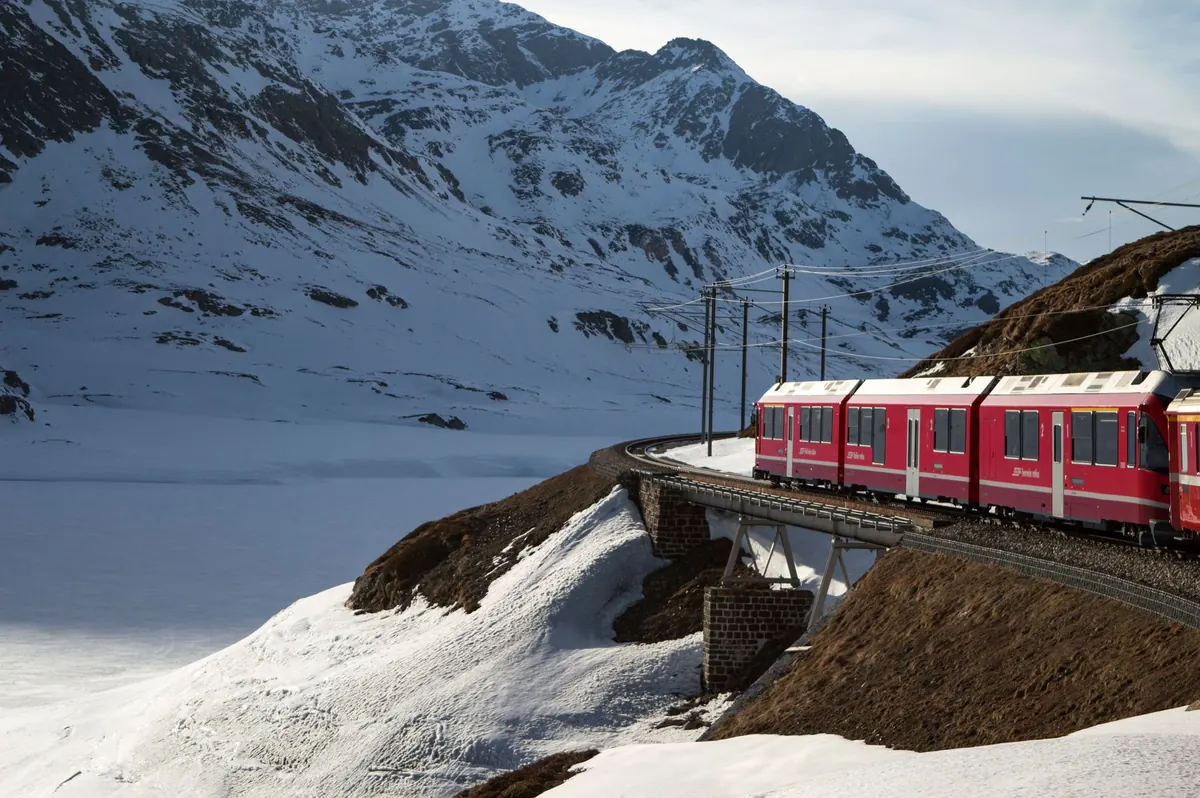
The train is one of the most civilized ways to reach the Italian Alps in winter. You avoid icy passes, rental-car paperwork and the search for a parking space under falling snow. But a station in the valley is rarely the same thing as a ski lift, and the gap between the two is where beginners get caught. The good news is that with a little planning, the whole journey feels simple.
The reward is not just practical. A winter train ride into the Alps has its own pleasure: frosted fields, small stations, villages stacked against the mountainside and the first proper view of snow from a warm window. You arrive rested rather than white-knuckled, and you do not have to spend the first evening of your holiday scraping ice off a hire car.
This guide is for the first-timer: someone who can read a timetable, pack a sensible bag and wants to arrive in the mountains without a small adventure at every connection.
It assumes you are travelling with normal winter luggage, probably a suitcase or a large backpack, and that you would rather know the awkward parts in advance than discover them on a dark platform with a bus leaving in four minutes.
Start with the resort, not the station. Italy’s Alpine rail network is good, but it was built for towns and freight as much as for skiers. That means you often travel to a gateway town and finish by bus, shuttle or taxi. Deciding on the valley first keeps you from booking a cheap ticket to a station that leaves you stranded.
This is the single most useful habit for a beginner: work backwards from your accommodation. Find the nearest bus stop or shuttle point, then find the rail station that serves it, then find the train that reaches that station. If you book the train first, you may end up with a beautiful journey to a town that is still an hour and a half from your ski boots.
Some common patterns are worth knowing. For the Aosta Valley, trains run from Turin to Aosta, with bus connections onward to Courmayeur and La Thuile; Cervinia is usually reached by train to Châtillon-Saint-Vincent, then a local bus up the valley. In Piedmont, trains from Turin serve the Susa Valley, including Oulx and Bardonecchia, with buses onward to places such as Sauze d’Oulx and Sestriere. For the Valtellina, trains from Milan continue toward Sondrio and Tirano, with buses climbing to Bormio and Livigno. For the Dolomites, Bolzano, Trento and Belluno are useful rail gateways, but you will almost always finish the journey by bus.
Do not book a ticket to “the Alps.” There is no such station. The Alps are a range, not a stop, and the last connection is usually the one that decides whether your day is easy or memorable for the wrong reasons.
The last mile is the part most beginners underestimate. On a summer hike, a missed bus might mean an hour in a café. In winter, with luggage and fading light, it can mean an expensive taxi or a long wait in a cold village. Check the bus or shuttle timetable before you book the train, and check it again for the day you travel.
Winter timetables are often thinner than summer ones. Some resort shuttles run only when hotels are busy, some local buses stop early, and Sunday service can be almost decorative. If your train arrives at 16:40 and the last bus leaves at 16:30, the cheap ticket is no longer cheap.
A gateway town is where the railway ends and the mountain road begins. Aosta, Oulx, Châtillon-Saint-Vincent, Sondrio, Tirano, Bolzano and Belluno are all useful examples. They are not failures of planning; they are simply the point where you switch from steel to rubber. Choose accommodation with this in mind, especially for the first night. A hotel near the station can be worth more than a cheaper room three bus stops away when you arrive after dark with a suitcase.
Buses are the cheapest and most common option. Resort shuttles are convenient when they match your train, but they often require booking and may run only at set times. Taxis are expensive but useful for groups, late arrivals or short final hops where the bus stop is uphill from the hotel. Before you travel, save the local taxi number and the bus company’s website, not just a screenshot of the timetable.
If a connection looks tight, treat it as impossible. In winter, a ten-minute train delay plus a five-minute walk to the bus stop is not a ten-minute connection; it is a missed bus.
For the rail part, use the national train operators and regional operators, and pay attention to whether your ticket includes a reservation. High-speed and long-distance trains usually require one, while regional trains often do not. A reservation is not just bureaucracy: it means you are not standing in the vestibule with ski boots and a suitcase for three hours.
Buy tickets in advance when it saves money, but do not over-optimise. A slightly later train with a comfortable margin is often better than a tightly timed sequence that saves a few euros and adds a day of stress. If you are changing from a long-distance train to a regional one, aim for at least 30 to 60 minutes in the larger stations, and longer if you must cross a city to a different station.
Build buffers into the journey, especially for the final bus. If the last bus leaves at 18:00, try to arrive in the gateway town by 16:30 or 17:00. That gives you time to find the stop, buy a snack, use the toilet and absorb a delay without panic. If you are travelling on a Sunday or a public holiday, add more buffer, not less.
Keep your tickets and reservations in one place, either on your phone or in a small folder. Paper regional tickets sometimes need validation before boarding, so check the rules for the specific operator. It is a small detail that catches visitors out.
Pack for two journeys, not one. The train is warm and dry; the platform and bus stop may be cold, windy and icy. Wear or carry a warm layer, gloves and a hat rather than burying everything in checked luggage. If your suitcase is heavy, remember that you may have to lift it onto a bus, up a step or along an icy pavement.
Label your luggage with your name and phone number. It sounds old-fashioned until the one moment your bag is lifted off the bus by someone else in a hurry.
Winter travel rewards a calm routine. Arrive at the station early enough to find the platform without rushing, and check the departure board rather than relying only on your printed plan. In Italy, platform numbers can change, and regional trains may leave from a different track than the one shown online.
Snow can slow everything down, but it rarely makes the journey impossible. The bigger risk is a tight connection and a lack of information. Save the local bus company’s number and your hotel’s number, and keep a power bank in your bag. If a connection fails, go back to the station or a nearby café, ask for help and focus on the next safe option rather than the perfect one.
When you finally reach the resort, resist the urge to do everything at once. Find your accommodation, leave your bags and take a short walk to orient yourself. Locate the ski lift, the ticket office, the bus stop and a shop for essentials. If you are skiing the next day, rent equipment in the afternoon if possible, when shops are less busy than on a fresh powder morning.
Ask your host two simple questions: where is the nearest bus stop for the valley, and what is the last return time? These small pieces of local knowledge are worth more than a dozen generic guides. Then eat something warm, check the weather forecast and let the journey end properly.
The beginner who plans the valley, the gateway town and the last mile is the one who steps off the train feeling clever rather than lucky. The train remains the most civilized way into the Italian Alps in winter; it just helps to know exactly where the rails end and the mountain begins.
Photo: Oleksandr Lutsenko / Pexels