Trending

Most first family ski holidays go wrong in the planning, not on the mountain. The snow is usually fine, the lifts usually run, and children usually discover they like sliding downhill. What spoils the week is a two-hour transfer after a 5am flight, a hotel four hundred metres from the lift with a five-year-old in hard boots, or a resort where the only way back to the village is a red run that turns icy at four o'clock.
So before you compare piste maps or look at photographs of sunny terraces, decide what your family actually needs. Four things matter more than anything else: how long it takes to get there, how big the place is, what the beginner terrain looks like, and who is looking after your children when you are not.
Transfer time is the single most underrated factor in a first ski trip. A resort that is ninety minutes from the airport will feel generous and forgiving. A resort that is three hours away over a mountain pass will feel like an ordeal, especially if you land in the evening and the children have already been travelling since dawn.
As a rule of thumb, aim for a maximum of two hours door to door from the airport, and be honest about what happens at the end of that journey. A valley village with a short, flat drive to the hotel is easier than a high resort reached by a winding road that requires chains in bad weather. If you are travelling to the Italian Alps, the Brenner corridor and the main South Tyrolean valleys are well served by rail and shuttle connections, which can spare you the hire car entirely.
An early flight plus a long drive equals a miserable first evening. If you cannot avoid a late arrival, book a hotel near the airport for the first night and drive up in the morning. You will lose nothing and gain a calm start.
It is tempting to book the famous linked area with hundreds of kilometres of piste. Resist it for year one. A beginner family skis perhaps ten to fifteen per cent of any large ski area, and the rest of it becomes expensive scenery you never touch. What you pay for in a big resort is choice, and beginners do not need choice. They need repetition.
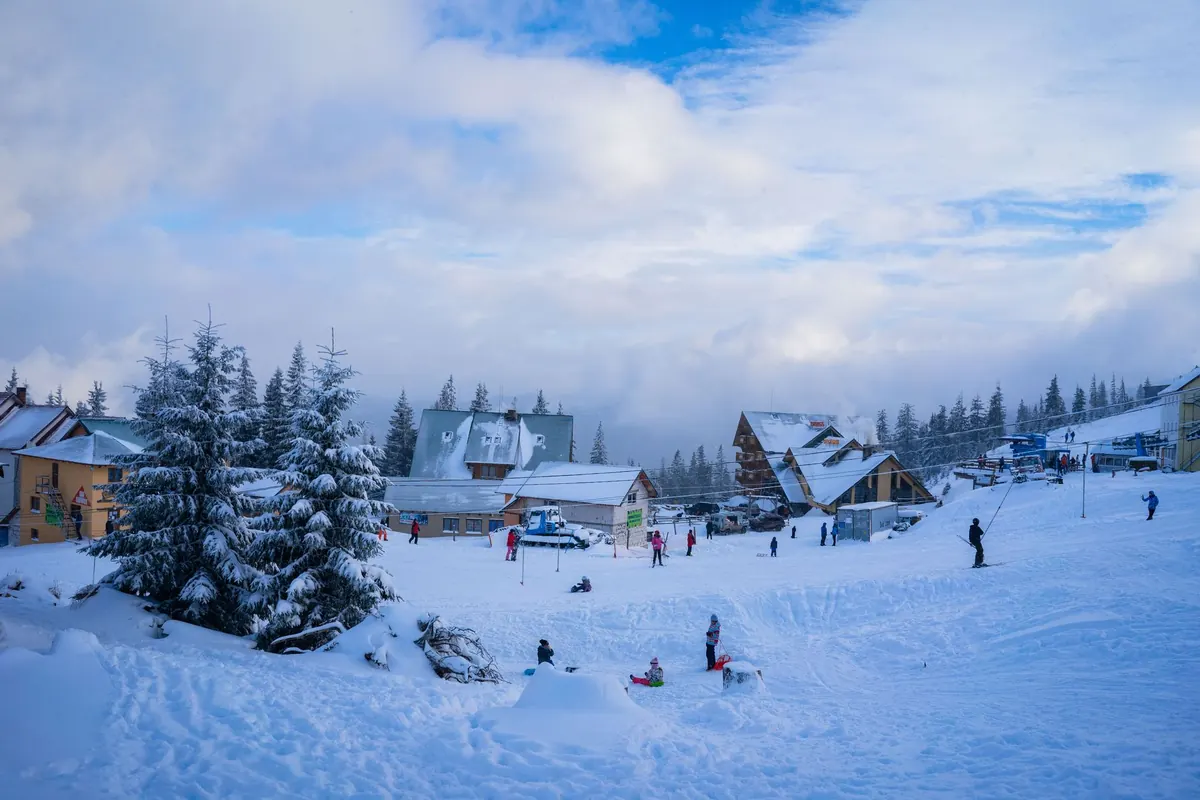
A small or medium resort, somewhere in the range of thirty to a hundred kilometres of piste, tends to work better. One base area. Everything within walking distance. A short lift ride to the nursery slope. Children learn faster when the routine is the same every morning, and parents relax when nobody has to navigate a bus timetable with skis on their shoulder.
Small South Tyrolean areas such as Ladurns, Villnöss or Carezza suit this brief well. The Alpe di Siusi is larger but unusually gentle across its whole plateau, which is why it attracts families year after year. Serfaus-Fiss-Ladis is big, yet its family infrastructure is so thoroughly thought through that size stops being a problem. The lesson is not "always go small" but "check what the size costs you in walking, busing and decision-making".
Beginners need width, not length. A wide blue run with a gentle gradient teaches more in three days than a narrow, twisting path that terrifies a seven-year-old. Look for a dedicated beginner zone at village level, ideally served by a magic carpet or a short chairlift, with a slope that funnels back to the same point.
Then check the way down. In some resorts the only route to the base is a red run that is fine in the morning and scraped bare by mid-afternoon. If your children cannot ski it comfortably, your day ends when the last easy route closes.
Group lessons vary enormously. Ask about the maximum group size, the language the instructor will use, and whether children eat lunch with the group or come back to you. Ask what happens if a child refuses to ski on day three, which is common and entirely normal. A good ski school has an answer for that.
Childcare needs the same scrutiny. If there is a kindergarten or miniclub at the lift base, confirm the age range, the daily hours, the staff-to-child ratio, and whether the children go outside on snow. A warm room with toys and a nap corner is useful; a warm room with toys and no outdoor time is not really a ski holiday for anyone.
Book lessons and childcare before you arrive, particularly in February and around Christmas. Peak weeks fill months ahead, and the flexible, small-group option is always the first to go. If you want a half-day arrangement so that one parent can ski while the other stays with a toddler, say so when you book rather than hoping to arrange it on the spot.
Ski-in, ski-out is worth more than it sounds. So is a hotel with an early dinner sitting, because a hungry six-year-old at eight in the evening is a problem no restaurant can solve. Apartments offer flexibility, a washing machine and the option to eat at six; half-board hotels offer the luxury of not cooking. Choose according to your tolerance, not your budget alone.
If you cannot have ski-in, ski-out, look for a ski depot at the lift station. Leaving boots and skis in a heated locker at the bottom removes the worst part of the day: the walk in hard plastic boots carrying someone else's equipment. Four hundred metres is a pleasant stroll in trainers and a small expedition in ski boots.
Rent equipment at the base rather than in town, book it online before you travel, and do not buy before you go. Children's feet grow, and rental shops are set up for exactly that.
The best first family ski trip is not the one with the most impressive mountain. It is the one where the least confident person in your group has a good time every single day. If that is a five-year-old, build the week around short mornings, a long lunch, and one gentle slope that becomes familiar. If it is a grandparent who has not skied in twenty years, the same logic applies.
Book the smallest resort that gives you what you need, keep the transfer short, and leave one day completely unplanned for weather, tiredness or a morning spent building snowmen. You can chase the big linked areas in a few years. The first trip only has to work once, and the way to make it work is to make it easy.
Photo: Atlantic Ambience / Pexels